Online Holistic Health Courses That Fit Real Life
Online holistic health courses can help turn confusing wellness information into practical, everyday knowledge. Discover what to look for in a quality course, how holistic learning can support your wellbeing, and why ongoing guidance and community can make healthy changes easier to sustain.
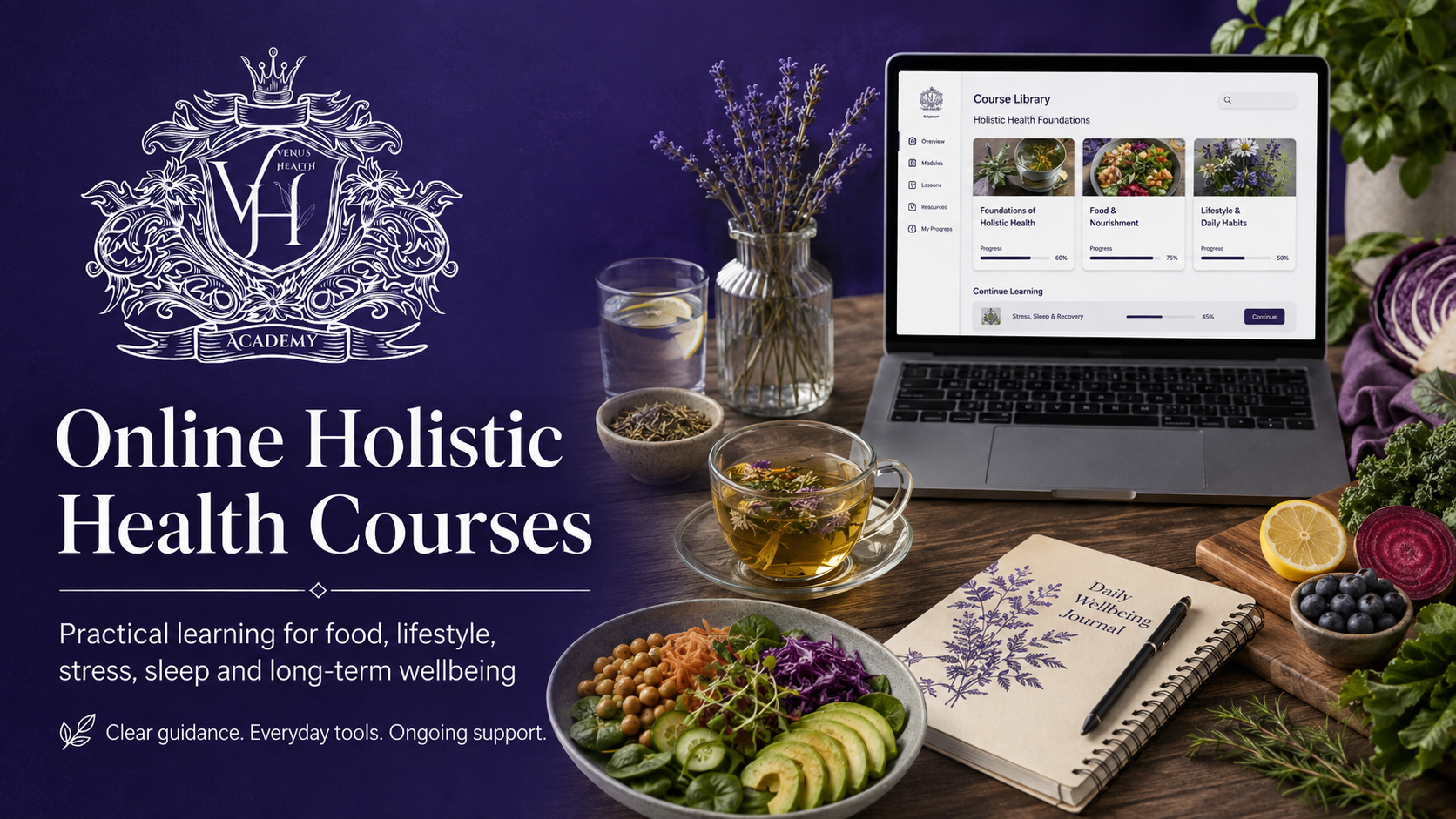
A cupboard full of supplements, a saved folder of wellness posts and a lingering sense that something is still being missed can leave people more overwhelmed than supported. Online holistic health courses offer a more useful starting point: trusted learning that helps you understand the connections between food, daily habits, stress, sleep, emotions and long-term wellbeing.
The right course does not promise a quick fix or ask you to follow a one-size-fits-all plan. It gives you practical tools to ask better questions, make informed choices and build changes you can realistically sustain. For wellness professionals, it can also strengthen the way you support clients with clarity, care and appropriate boundaries.
Why holistic learning needs to be practical
Holistic health is sometimes presented as an enormous subject, full of complicated theories and conflicting advice. In real life, it is about recognising that health is rarely shaped by one factor alone. A person’s energy, digestion, mood, skin, sleep and resilience may be influenced by their routines, nourishment, relationships, environment and medical history, as well as the support available to them.
That does not mean every concern has a single hidden root cause, or that natural approaches should replace medical care. It means looking beyond symptom-only decisions and considering the wider picture. Good education helps you hold both ideas at once: honouring the body’s signals while knowing when assessment from an appropriately qualified healthcare professional is needed.
The most valuable learning is therefore not simply information to memorise. It is information you can use on an ordinary Tuesday. It helps you read an ingredient label with more confidence, create meals that support your goals, prepare thoughtful questions for an appointment, or notice how a rushed evening routine is affecting your sleep.
What to look for in online holistic health courses
Course titles can sound very similar, yet the experience and quality can vary greatly. Before committing your time and money, look beyond a long list of modules. Consider whether the teaching is grounded, accessible and designed to support action rather than passive watching.
Clear teaching without unnecessary jargon
A course should explain the ‘why’ behind recommendations in language you can understand. You should not need a clinical qualification to grasp foundational topics such as balanced nutrition, blood sugar awareness, nervous system support, gut health or emotional wellbeing. Equally, the material should not oversimplify complex health concerns or make dramatic claims.
For practitioners and coaches, clear teaching matters for another reason. It can help you communicate with clients in a way that is empowering rather than alarming. Knowledge becomes more useful when people feel able to act on it.
Resources that turn knowledge into routines
Education becomes far more effective when it comes with ways to apply it. Recipe videos, downloadable guides, food ideas, protocols, reflection prompts and practical trackers can help turn a lesson into a lived habit.
Think about the format that suits your life. If you are supporting clients, you may value structured frameworks and resources that help guide conversations. If you are learning for yourself, short lessons and simple meal inspiration may be easier to return to than a demanding course that must be completed in a fixed timeframe.
Space for questions and community
Health learning can feel deeply personal. A supportive community makes it easier to stay engaged when motivation changes, when a concept needs clarification or when you want to hear how others are approaching a similar goal.
Live group coaching and interactive events can add a human layer that self-paced videos cannot always provide. They also create accountability without judgement. The aim is not to get everything perfect. It is to keep learning, adjust thoughtfully and feel less alone in the process.
Responsible scope and balanced guidance
Be cautious of any programme that claims to diagnose, cure or guarantee outcomes. Responsible holistic education respects the limits of online learning and encourages informed collaboration with qualified medical professionals where necessary, particularly for persistent symptoms, medication decisions, pregnancy, mental health concerns or existing conditions.
For professionals, scope matters especially. Further training should build confidence in health education and lifestyle support, while making clear when referral is the safest and most ethical next step.
Choose a learning path that matches your starting point
The best course for a beginner may not be the best course for an experienced wellness practitioner. Your choice should reflect what you need now, not what sounds most impressive.
If you are new to natural health, begin with foundations. Learn how daily nourishment, hydration, movement, rest and stress patterns can influence wellbeing. Focus on small, repeatable changes before moving towards more specialised topics. A clear foundation can prevent the common cycle of trying five new practices at once, then abandoning all of them when life becomes busy.
If you are managing persistent concerns, you may be looking for greater context around test results, nutrition strategies or lifestyle patterns. Education can help you prepare for more meaningful conversations and notice useful patterns, but it should sit alongside personalised clinical advice when that is appropriate. Your experience is individual, and a course cannot see every part of your health history.
If you work with clients, seek learning that is both evidence-aware and practical. You may want protocols, coaching approaches, client-friendly resources and opportunities to discuss real-world challenges with a knowledgeable community. The goal is not merely to collect another certificate. It is to become better equipped to support people calmly, ethically and effectively.
Make your course work in real life
Even an excellent programme will not create change if it becomes another tab left open on your laptop. A simple learning rhythm can make a significant difference.
Start by choosing one area of focus for the next few weeks, such as improving breakfast, creating a calmer evening routine or learning more about digestion. Watch one lesson at a time, then identify one action you are willing to test. Keep the action small enough that you can do it on a busy week, not just on your most organised week.
It can help to keep a brief note of what you notice. This is not about scrutinising every bodily sensation. It is about building awareness. You might record your energy after meals, the quality of your sleep, how a new recipe felt to prepare, or whether a five-minute pause before bed made your evening feel less rushed.
For practitioners, translate each lesson into one client-support tool. Perhaps that is a clearer question to ask during an intake, a food education handout, or a more compassionate way to discuss consistency. Small professional improvements compound over time, just as personal habits do.
Education is stronger with ongoing support
A standalone course can be a helpful introduction, but wellbeing rarely follows a neat start-and-finish timeline. Needs change with seasons, workloads, family life, new symptoms and evolving goals. Ongoing support gives you somewhere to return when you need a refresher, a new perspective or motivation to continue.
This is where a membership-based learning community can be particularly valuable. At Venus Health Academy, courses sit alongside practical wellness resources, recipe videos, group coaching, live events and personalised consultation options. That wider environment supports both the person taking early steps towards better wellbeing and the professional developing their client support skills.
The value is not in doing more for the sake of it. It is in having trusted natural health knowledge, practical guidance and a supportive global learning community available when you are ready to use them.
Let curiosity lead, not pressure
There is no prize for changing your entire lifestyle in a fortnight. Lasting vitality is more often built through steady attention: learning what supports you, questioning advice that does not fit, and giving yourself room to adapt.
Choose education that leaves you feeling clearer, more capable and more connected to your own wellbeing. Then let one useful lesson become one kind, practical choice today.