Could Nicotine Be The New Discovery For Brain Degenerative Diseases?
Nicotine is far more biologically complex than many people realise. Research is exploring its effects on the brain, attention, dopamine, Parkinson’s disease, ADHD, ulcerative colitis, inflammation and pain. In this short evidence-based article, we look beyond smoking and examine what the science actually says about nicotine.
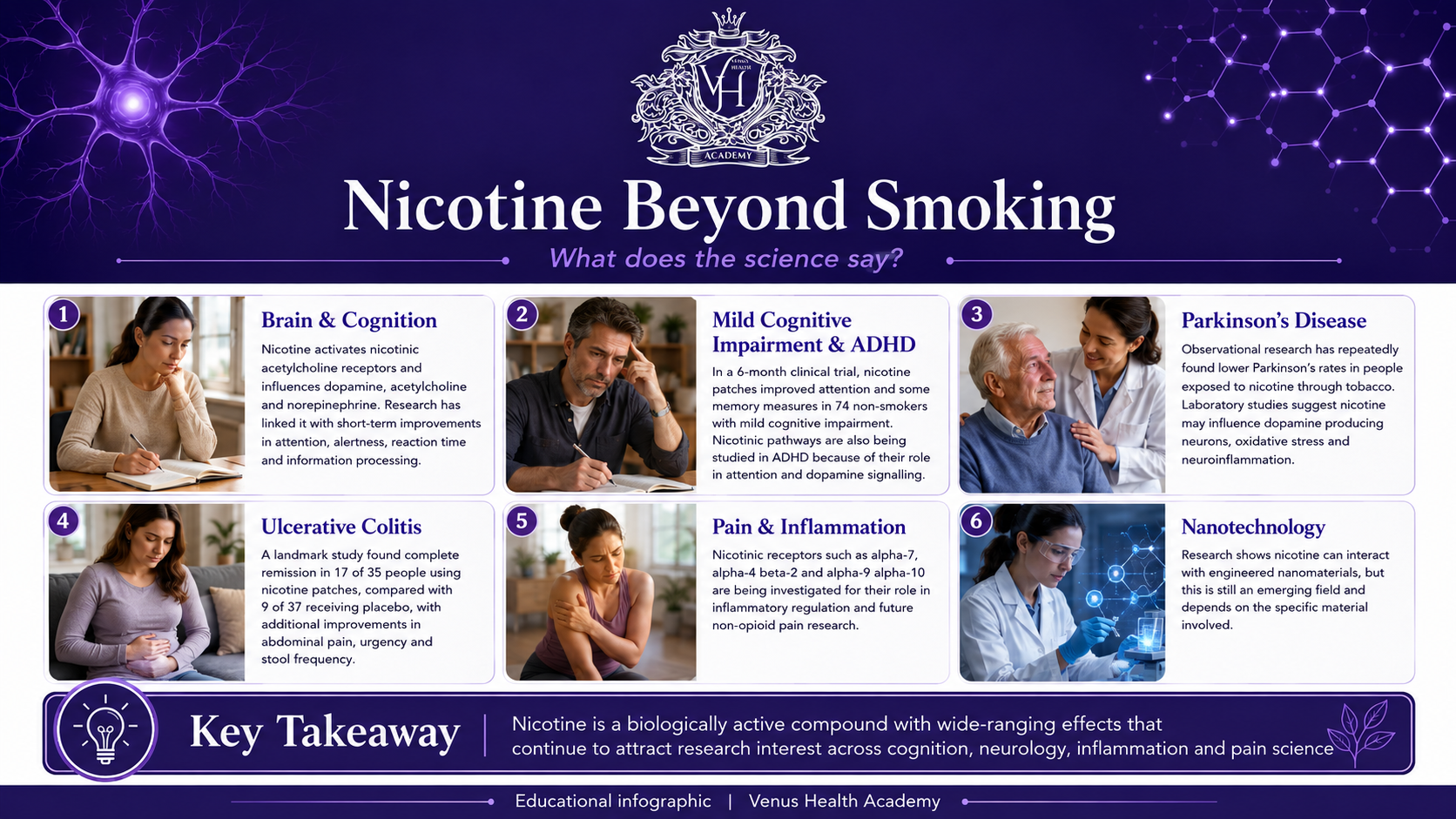
Nicotine Beyond Smoking: What Does the Science Say?
Nicotine is usually associated with cigarettes, but nicotine itself is a separate naturally occurring compound that acts on nicotinic acetylcholine receptors throughout the brain and body.
These receptors influence attention, memory, dopamine signalling, movement, inflammation and pain — which is why nicotine continues to attract scientific interest.
Brain Function and Cognitive Performance
Nicotine stimulates nicotinic acetylcholine receptors and increases activity involving neurotransmitters such as dopamine, acetylcholine and norepinephrine.
Research has found short-term improvements in:
attention and alertness
reaction time
concentration
working memory
information processing.
A major meta-analysis of 41 double-blind, placebo-controlled studies found significant improvements across several areas of cognitive performance.
Another analysis involving 31 studies and 978 healthy non-smokers found that nicotine patches significantly improved overall cognitive performance and attention.
Cognitive Decline and ADHD
Researchers have also explored nicotine in neurological conditions.
In a six-month clinical trial involving 74 non-smokers with mild cognitive impairment, nicotine patches improved attention and several measures of memory and psychomotor performance.
Nicotinic receptors are therefore being investigated in relation to Alzheimer’s disease and cognitive decline.
Nicotine has also been studied in ADHD because of its effects on attention and dopamine signalling. Research into these pathways could help scientists develop new treatments that target nicotinic receptors more precisely.
Parkinson’s Disease
One of the most fascinating areas of research involves Parkinson’s disease.
For decades, observational studies have found lower rates of Parkinson’s disease among people exposed to nicotine through tobacco.
Scientists are investigating whether nicotine may influence the survival and function of dopamine-producing neurons, which are progressively affected in Parkinson’s disease.
Laboratory research suggests nicotine may influence:
dopamine signalling
oxidative stress
neuroinflammation
cellular stress responses
neuronal survival.
A Journal of Neuroscience study found that nicotine reduced cellular stress responses in cultured dopamine-producing neurons.
This remains an active and important area of neurological research.
Ulcerative Colitis
Nicotine has also produced interesting results in ulcerative colitis.
In a landmark New England Journal of Medicine study of 72 people with active ulcerative colitis:
17 of 35 people receiving nicotine patches achieved complete remission, compared with 9 of 37 receiving placebo.
Participants also experienced improvements in abdominal pain, urgency and stool frequency.
These findings have helped researchers understand how nicotinic receptors interact with inflammatory pathways in the digestive system.
Pain and Inflammation
Nicotinic receptors are closely involved in communication between the nervous and immune systems.
Scientists are particularly interested in the alpha-7 nicotinic acetylcholine receptor, which plays an important role in the body's cholinergic anti-inflammatory pathway.
Nicotinic receptors including α7, α4β2 and α9α10 are also being investigated as potential targets for future non-opioid approaches to pain.
What About Nanotechnology?
There are also claims that nicotine interacts with or breaks down nanotechnology.
Scientific research confirms that nicotine can interact with engineered nanoparticles and nanomaterials, although exactly how these interactions occur depends on the material involved.
For example, researchers have demonstrated interactions between nicotine and silver, copper, titanium-dioxide and graphene-based nanomaterials.
This remains an emerging area of research, and more studies are needed to determine whether nicotine can directly break down particular nanostructures inside biological systems.
The Bigger Picture
Nicotine is far more biologically complex than many people realise.
Research continues to explore its relationship with:
cognition, memory, ADHD, Parkinson’s disease, ulcerative colitis, inflammation and pain.
Perhaps the most exciting aspect of this research is what nicotine is teaching scientists about nicotinic acetylcholine receptors — receptors that could eventually become important targets for future neurological, inflammatory and pain treatments.
Scientific References
Heishman SJ, Kleykamp BA, Singleton EG. Psychopharmacology. 2010;210:453–469. PMID: 20414766.
Majdi A, Sadigh-Eteghad S, Gjedde A. Acta Neurologica Scandinavica. 2021;144:179–191. PMID: 33899218.
Newhouse P, Kellar K, Aisen P, et al. Neurology. 2012;78:91–101. PMID: 22232050.
Levin ED, Conners CK, Sparrow E, et al. Psychopharmacology. 1996;123:55–63.
Pullan RD, Rhodes J, Ganesh S, et al. New England Journal of Medicine. 1994;330:811–815. PMID: 8114833.
Srinivasan R, Henderson BJ, Lester HA, Richards CI. Journal of Neuroscience. 2016. PMID: 26740650.
Cheng J, Chang J, Li S. Frontiers in Pharmacology. 2026. PMID: 42256394.
Bjørklund G, Gurgas L, Hangan T. Neurochemical Research. 2026. PMID: 42545429.
Tian ZR, Sharma A, Muresanu DF, et al. International Review of Neurobiology. 2023;172:189–233. PMID: 37833012.
Maiti M, Sarkar M, Liu D. Catalysis Science & Technology. 2020;10:2797–2809.