The Many Roles of Cortisol in the Body: Why It's More Than Just the "Stress Hormone"
Cortisol has a reputation problem. It gets blamed for belly fat, burnout, and sleepless nights. But this so-called stress hormone is actually one of your body's most essential allies. It fuels your morning energy, regulates blood sugar, calms inflammation, and even supports a healthy pregnancy. It follows a precise daily rhythm, rising with the sun and fading as night falls.
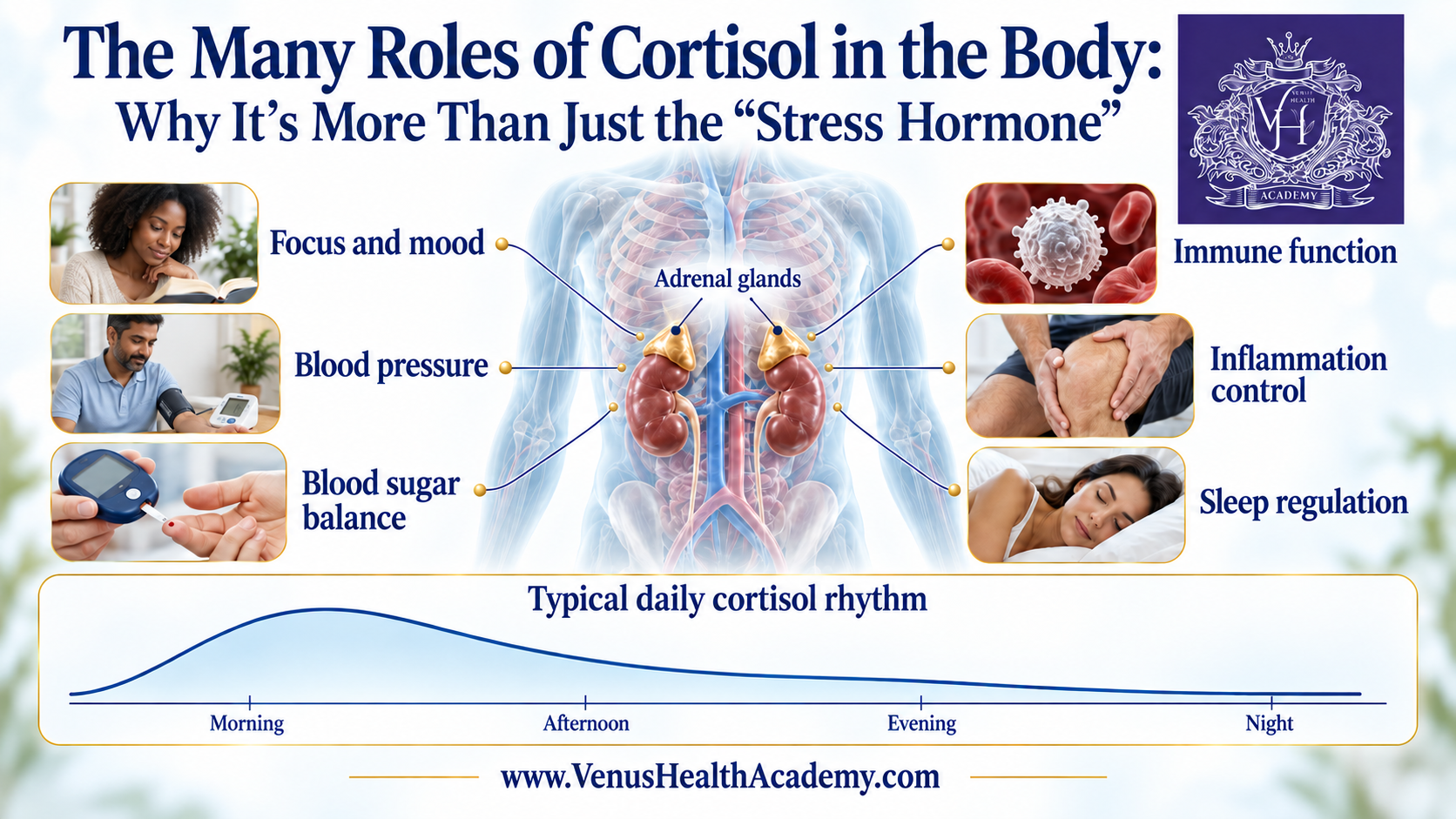
Cortisol often gets painted as the villain of the hormone world, the culprit behind belly fat, anxiety, and burnout. But at Venus Health Academy, we believe in looking deeper. Cortisol is not your enemy; it is one of your body's most essential and hardworking messengers. When balanced, it powers your mornings, fuels your workouts, and helps you heal. When chronically out of sync, it can quietly undermine your health.
Understanding cortisol’s full scope is the first step toward respecting it rather than fearing it.
What Exactly Is Cortisol?
Cortisol is a steroid hormone produced by your two adrenal glands, which sit atop your kidneys like small hats . It is often called the “stress hormone,” but that label barely scratches the surface. Nearly every cell in your body has receptors for cortisol, meaning it influences almost every organ system, from your brain and heart to your immune system and skin .
Your body continuously monitors and adjusts cortisol levels to maintain homeostasis, a steady internal balance . When this balance is disrupted, you feel it.
The Daily Rhythm of Cortisol
Cortisol does not flow steadily; it follows a predictable daily curve known as the diurnal rhythm. In a healthy pattern, cortisol surges within 30 minutes of waking, sometimes by as much as 150% giving you the energy and focus to start your day . This is called the Cortisol Awakening Response.
From that morning peak, levels gradually decline through the afternoon and reach their lowest point around midnight, roughly 15 times lower than the morning high . This evening dip is what allows your body to wind down, repair tissues, and prepare for restorative sleep .
Beneath this daily arc, cortisol also pulses in smaller waves every 60 to 120 minutes even during sleep . This rhythm is part of why you experience natural windows of focus and fatigue throughout the day.
The Many Roles of Cortisol
Cortisol is far more than a stress signal. It is a metabolic regulator, an immune modulator, and a cardiovascular stabiliser.
Metabolism and Blood Sugar Regulation
Cortisol helps regulate how your body uses glucose, fats, and proteins for energy . During times of stress, it triggers the release of stored glucose from your liver to provide fast fuel . It also modulates insulin and glucagon, the hormones that keep blood sugar in check . Without cortisol, your body would struggle to maintain steady energy between meals.
The Stress Response
When you face a perceived threat, a swerving car, a looming deadline, your hypothalamus signals your pituitary gland, which tells your adrenal glands to release adrenaline and cortisol . Adrenaline gives you the immediate jolt; cortisol keeps you going. It maintains blood sugar, sharpens alertness, and suppresses non-essential functions like digestion so you can focus on survival .
Inflammation and Immune Function
In short bursts, cortisol is powerfully anti-inflammatory. It limits inflammation and supports immune balance . However, when cortisol remains elevated for prolonged periods, the immune system can become desensitised, potentially leading to chronic inflammation and weakened defences .
Blood Pressure and Cardiovascular Health
Cortisol helps maintain blood pressure by regulating sodium retention and vascular tone . Too little cortisol can cause low blood pressure; chronically high levels can contribute to hypertension .
Sleep-Wake Cycle
That morning cortisol spike is not a coincidence—it plays a key role in initiating wakefulness . The evening decline signals to your body that it is time to rest. Disrupt this rhythm, and sleep quality suffers.
Growth and Development
Cortisol supports the growth and development of an unborn baby during pregnancy . In children and adults, it interacts with growth hormone and thyroid function, though chronic excess can suppress these pathways .
When Cortisol Goes Out of Balance
Cortisol is essential, but balance is everything. Consistently high or low levels can signal underlying conditions.
Too Much Cortisol: Cushing’s Syndrome
Cushing’s syndrome is a rare condition caused by prolonged high cortisol, often from steroid medications or tumours on the pituitary or adrenal glands . Symptoms include weight gain around the abdomen and face, thinning skin that heals slowly, easy bruising, muscle weakness, high blood pressure, and mood changes such as anxiety or depression .
Importantly, everyday stress does not cause Cushing’s syndrome. Normal stress-related cortisol spikes are temporary and do not lead to this condition .
Too Little Cortisol: Addison’s Disease
Addison’s disease occurs when the adrenal glands do not produce enough cortisol, often due to autoimmune damage . Symptoms include extreme fatigue, weight loss, low blood pressure, salt cravings, nausea, and dark patches on the skin . Severe deficiency can trigger an Addisonian crisis, a medical emergency requiring immediate treatment .
What This Means for You
Most people will never develop Cushing’s or Addison’s disease. But many of us live in a grey zone of chronic stress, poor sleep, and irregular schedules that can disrupt cortisol’s natural rhythm .
The good news is that you do not need to obsess over a single cortisol number. What matters more is the shape of your rhythm over time—how high your morning peak rises, how consistently it falls, and whether that pattern holds across different seasons of life .
At Venus Health Academy, we encourage a proactive, balanced approach. The most evidence-based ways to support healthy cortisol levels are the fundamentals: regular movement, balanced nutrition, consistent sleep, and genuine stress management . These are not glamorous fixes, but they are the ones that work.
Cortisol is not a villain. It is a vital, complex hormone that deserves your respect, and your understanding.
What Exactly Is Cortisol?
The role of cortisol in the body
www.healthdirect.gov.au/the-role-of-cortisol-in-the-body
The Daily Rhythm of Cortisol
Negative Emotionality, Depressive Symptoms and Cortisol Diurnal Rhythms
www.pmc.ncbi.nlm.nih.gov/articles/PMC3126866
Awakening not associated with an increased rate of cortisol secretion
www.pmc.ncbi.nlm.nih.gov/articles/PMC11732391
Metabolism and Blood Sugar Regulation
Cortisol smooth curves by group and shift
www.push-zb.helmholtz-munich.de/deliver.php?id=36716
The dawn phenomenon: What can you do?
www.mayoclinic.org/diseases-conditions/diabetes/expert-answers/dawn-effect/faq-20057937
The Stress Response
The role of cortisol in the body
www.healthdirect.gov.au/the-role-of-cortisol-in-the-body
Inflammation and Immune Function
Corticosterone effects induced by stress and immunity and inflammation
www.frontiersin.org/journals/endocrinology/articles/10.3389/fendo.2025.1448750
Blood Pressure and Cardiovascular Health
Daytime plasma cortisol and cortisol response to dexamethasone suppression are associated with a prothrombotic state in hypertension
www.pubmed.ncbi.nlm.nih.gov/38836224
Sleep-Wake Cycle
On the interactions of the hypothalamic-pituitary-adrenal (HPA) axis and sleep
www.pubmed.ncbi.nlm.nih.gov/15728214
Growth and Development
The role of cortisol in the body
www.healthdirect.gov.au/the-role-of-cortisol-in-the-body
Too Much Cortisol: Cushing's Syndrome
Cushing's Syndrome - Condition Basics
www.myhealth.alberta.ca/health/tests-treatments/Pages/conditions.aspx?hwid=hw71646
Too Little Cortisol: Addison's Disease
Addison's disease - Symptoms and causes
www.mayoclinic.org/diseases-conditions/addisons-disease/symptoms-causes/syc-20350293
What This Means for You
The role of cortisol in the body
www.healthdirect.gov.au/the-role-of-cortisol-in-the-body