Beyond the Bad Reputation: Why Your Body Cannot Survive Without Cholesterol
Cholesterol is more than a number on a test result. Explore its essential role in cell repair, nerve support, hormone production and the body’s natural healing processes.
For decades, cholesterol has been cast as the villain in the story of heart health. We are told to lower it, avoid it, and fear it. But the truth is far more nuanced. Cholesterol is not a poison. It is a fundamental building block of life, essential for our survival. Without it, we would not exist.
In this article, we will explore the many vital roles this humble molecule plays in the human body, and why a complete absence of cholesterol would be catastrophic.
What Exactly Is Cholesterol?
Cholesterol is a waxy, fat-like substance that is found in every cell of your body. It is a type of lipid, or fat. It is produced naturally by your liver and is also obtained from certain foods, such as eggs, meat, and dairy products.
It is important to understand that cholesterol is not the same as triglycerides, another type of blood fat. Cholesterol travels through your bloodstream in packages called lipoproteins. These are commonly known as LDL (low-density lipoprotein) and HDL (high-density lipoprotein). While often labelled as "bad" and "good" respectively, both are simply transporters with different jobs. Neither is inherently evil.
The Essential Roles of Cholesterol
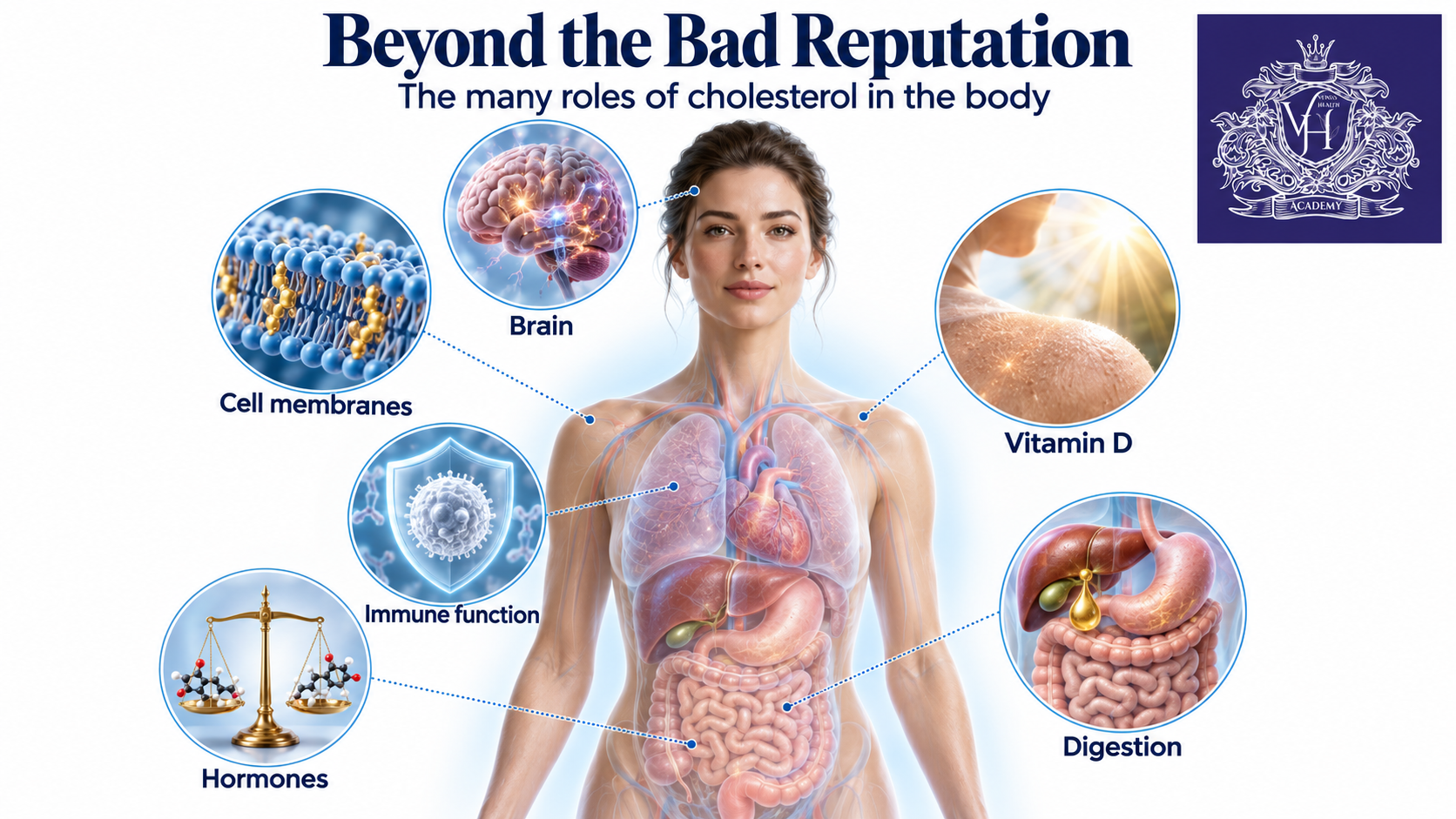
Far from being a mere troublemaker, cholesterol performs several indispensable functions.
1. It Builds and Maintains Cell Membranes
Every single one of the trillions of cells in your body is surrounded by a protective membrane. Cholesterol is a crucial component of this membrane. It fits between the fatty molecules that make up the membrane, acting like a stabiliser. It makes the membrane waterproof and controls its fluidity. This ensures that the cell can maintain its shape and that substances can pass in and out of it in a controlled way. Without cholesterol, our cells would simply fall apart.
2. It is a Precursor to Vital Hormones
Cholesterol is the raw material from which the body manufactures several critical hormones. These include:
Sex hormones: Testosterone, oestrogen, and progesterone are all built from cholesterol. These hormones are responsible for sexual development, fertility, and much more.
Adrenal hormones: The adrenal glands, which sit on top of your kidneys, use cholesterol to produce cortisol (the stress hormone) and aldosterone (which regulates blood pressure and salt balance).
If you had no cholesterol, your body could not produce these hormones, and your endocrine system would fail.
3. It Enables Vitamin D Production
When your skin is exposed to sunlight, a form of cholesterol in your skin is converted into vitamin D. This vitamin is essential for absorbing calcium and phosphorus, which are needed for strong bones and teeth. It also plays a role in immune function and muscle health. Therefore, cholesterol is a key player in the process that keeps your skeleton strong.
4. It is Crucial for Brain Function
The brain contains about 20 per cent of the body's total cholesterol, even though it makes up only about 2 per cent of body weight. Cholesterol is vital for the development of the brain and for the formation of synapses, the connections between nerve cells that allow them to communicate. It also insulates nerve fibres, helping electrical signals travel quickly and efficiently. A lack of cholesterol in the brain has been linked to cognitive decline and neurological disorders.
5. It Aids in Digestion
The liver uses cholesterol to produce bile acids. These acids are released into the small intestine to help break down and absorb dietary fats. Without bile, we could not digest fatty foods or absorb fat-soluble vitamins like A, D, E, and K. In this sense, cholesterol is a digestive aid.
6. It Supports the Immune System
Cholesterol is involved in the function of the immune system. It helps immune cells, such as macrophages and T-cells, to recognise and respond to pathogens. Some research suggests that cholesterol plays a role in how the body fights off infections. Therefore, a total absence of cholesterol would leave us more vulnerable to illness.
The Balance is Key
The problem arises not from cholesterol itself, but from an imbalance. When levels of LDL cholesterol become too high, it can build up in the walls of arteries, forming plaque. This can narrow the arteries and increase the risk of heart attack and stroke. This is why managing cholesterol levels through a healthy diet, regular exercise, and, if necessary, medication is important.
However, the goal should never be to eliminate cholesterol entirely. That would be impossible and, in fact, fatal. The aim is to maintain a healthy balance.
Conclusion
Cholesterol is a multifaceted molecule with a vital role in human biology. It is not a foreign invader but a home-grown necessity. From holding our cells together to enabling us to think, move, and reproduce, cholesterol is truly a building block of life. So the next time you hear the word, remember that it is not simply something to be lowered. It is something to be understood, respected, and kept in balance.
Cholesterol in Cell Membranes
Mouritsen, O. G., et al. (2004). What's so special about cholesterol? Lipids, 39(11), 1101–1113.
www.pubmed.ncbi.nlm.nih.gov/15726825/
Steroid Hormone Synthesis
De novo synthesis of steroids, oxysterols, and bile acids from cholesterol. (2013). National Institutes of Health.
www.pmc.ncbi.nlm.nih.gov/articles/PMC3887202/figure/F1/
Vitamin D Production
Shin, M. H., et al. (2019). UV increases skin-derived 1α,25-dihydroxyvitamin D3 production, leading to MMP-1 expression by altering the balance of vitamin D and cholesterol synthesis from 7-dehydrocholesterol. Journal of Steroid Biochemistry and Molecular Biology, 195, 105449.
www.snu.elsevierpure.com/en/publications/uv-increases-skin-derived-1%CE%B125-dihydroxyvitamin-dsub3sub-producti/
Cholesterol in Neurons and Brain Function
Cholesterol homeostasis and function in neurons of the central nervous system. (2003). Cellular and Molecular Life Sciences, 60(6), 1158–1171.
www.pmc.ncbi.nlm.nih.gov/articles/PMC11138592/
Bile Acids and Digestion
Clinical Significance of Bile Acids. (n.d.). Semantic Scholar.
www.pdfs.semanticscholar.org/presentation/d653/8281ee7e3726116db94d2cec11e983bcdc37.pdf
Cholesterol and the Immune System
Interaction of pathogens with host cholesterol metabolism. (2014). National Institutes of Health.
www.pmc.ncbi.nlm.nih.gov/articles/PMC4219984/
Overview and Public Information
Food Fact Sheet: Cholesterol. (n.d.). Willesden Green Surgery.
www.willesdengreensurgery.nhs.uk/_files/ugd/a03920_44da4cb4f6114f37a4dc723af3485dd0.pdf